
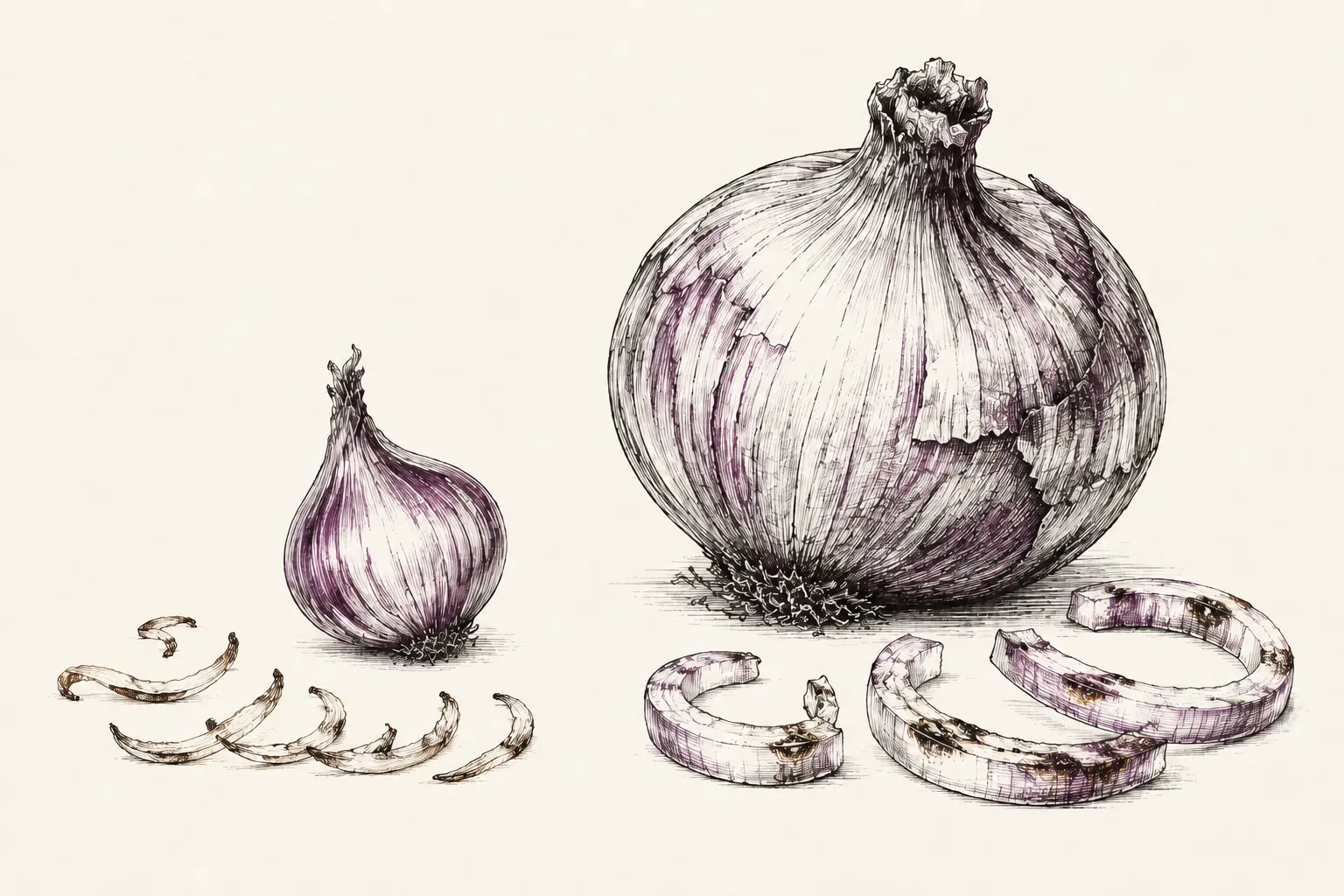
A note before I begin: I am writing this mostly in a North American context. I have not yet been able to dig my teeth into onions from enough other markets around the world to make a proper global analysis.
Someone pointed this out after my last essay, where I was venting about the difference between clarified butter and ghee. Fair enough. But that essay also touched on a larger frustration: how easily ingredients in Indian recipes are replaced without stopping to ask whether they can actually be replaced.
When a recipe written in India calls for an onion, it usually means what I know as a Bombay onion: a small red onion that rarely weighs much more than 55 or 60 grams. It sweeps across the subcontinent. Unless the recipe specifies something else—pran in Kashmir, perhaps, or Madras onions in the south—that is the onion I imagine.
When an Indian recipe is made in North America and calls for an onion, I stand in the supermarket and ask myself:
Okay. Which onion? Red, yellow, Spanish, white?
Let us focus on the red onion.
I have tried using the red onions available in North American supermarkets for Indian food. They are enormous compared with the ones back home—which is probably why you find so many half-cut onions in Indian fridges across Canada.
Their skins and layers feel more leathery when you bite into them. When you try to brown them, a crucial step in many Indian dishes, they colour unevenly and leave purple splotches that do not dissolve gracefully into a braise. The layers hold on to their water.
I have sliced them on a mandoline, salted them, washed them and squeezed out the excess water before frying them. That works reasonably well. You lose some pungency, but the sweetness is unparalleled.
Even then, they have never really replaced the Bombay onion for me.
The Bombay onion is sweeter while also being punchier than its North American cousin. Its texture is not leathery. It gives way with something closer to a pear-like crispness, which matters when the onion is served raw beside kebabs, tikkas and countless other dishes.
Slice it thinly and fry it, and it browns into a perfect crisp without all the extra processing.
An onion is not an abstract unit. It is flavour, water, structure and behaviour in a pan.
That is the larger point. These ingredients are substituted in Indian cooking as though their names alone make them interchangeable. It does not happen once. It happens at every stage of a recipe, and each small change compounds into a much larger difference on the plate.
If you cannot find Bombay onions, look for good-quality fried onions at an Indian supermarket. By good quality, I mean an ingredient list that reads onions and oil. No flour, maltodextrin or anything else.
They are not a blanket substitute, but they work very well in dishes where deeply browned onions are essential—especially biryani.
For raw applications, try Tropea onions. These Italian onions are excellent eaten raw and are the closest substitute I have found.
Next time, I will try to explain how Indian lemons are different.