Earlier in December, I was out shopping in the narrow lanes of Old Delhi—lugging heavy lehengas and figuring out the logistics of the Metro, cycle rickshaws and walking as we moved between clothing shops around Old Delhi and Chandni Chowk. We were also working through a list of places we wanted to eat in the shadow of the magnificent Jama Masjid.
These were modestly sized operations that turned their tables twenty times on a regular day, feeding anywhere from 800 to 2,000 people. The places in Chandni Chowk are filled with tourists and locals alike.
The last place I ate at was almost at the edge of what is considered Old Delhi. It was quite out of the way from the other places we visited, and on the final day, I was adamant about making sure I grabbed a bite there.
It was a pilgrimage of food for me, and eating at this place was the equivalent of kissing the Pope’s ring.
Let me set the scene for you. The context is important here.
Kallu Nihari serves one thing and one thing only: nihari—a historically rich and lush stew of whole pieces of shank meat, marrow bones and knuckles, cooked overnight and traditionally served in the early hours after morning prayers to business owners who would eat it for breakfast and go about their day. Nihar means morning, and nihari is an adjective derived from it: of the morning.
Keeping up with the times, Kallu opens at 5:00 p.m. instead of 5:00 a.m. What makes it exceptionally unique is that it closes by 5:45 p.m.—sometimes even 5:30.
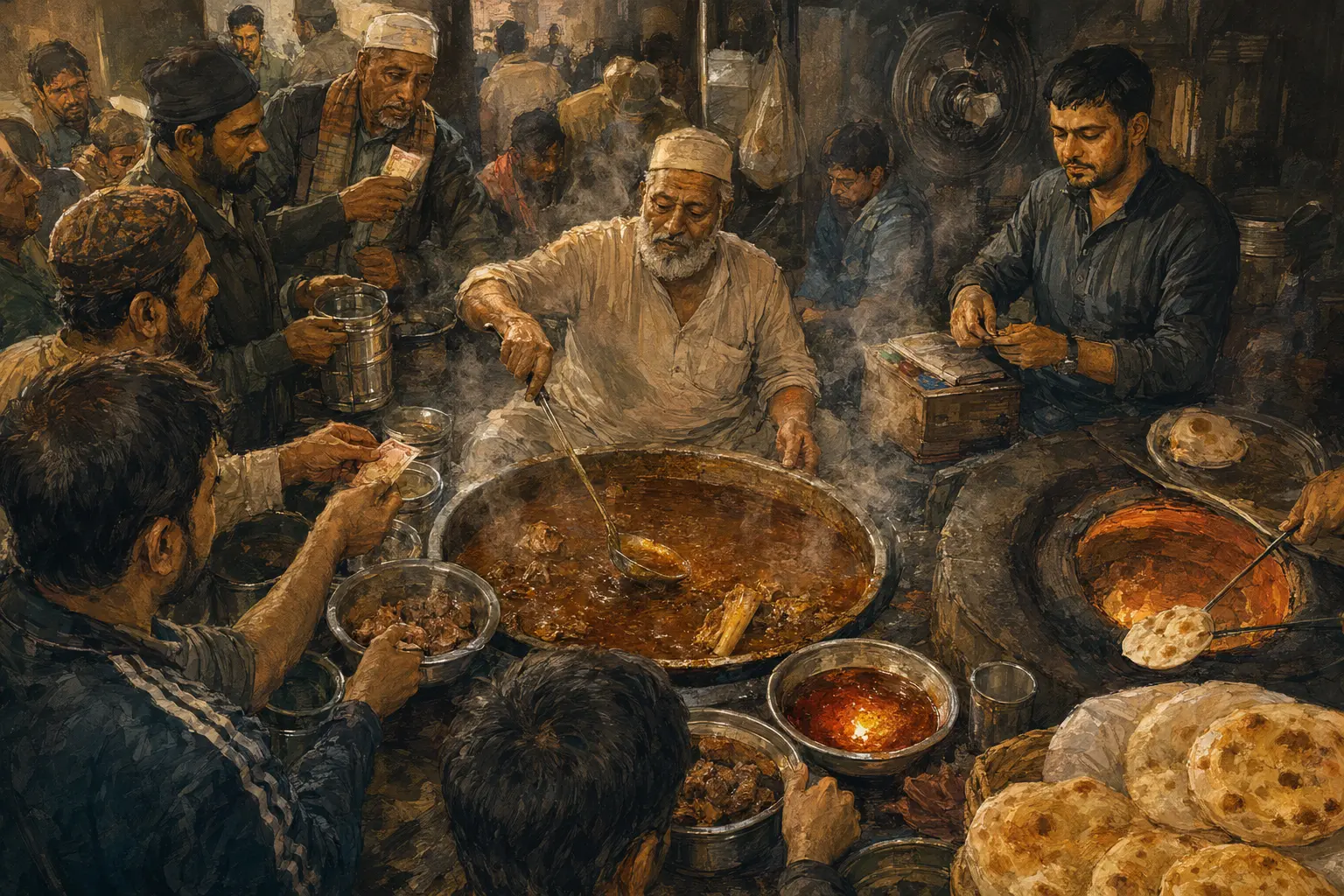
They do not turn many tables, because they do not have any tables. But by my estimate, they serve about 200 to 250 people, who take home varying amounts of nihari in large stainless-steel containers brought from their kitchens, along with khameeri roti wrapped in newspaper, swinging out of the tandoor nonstop.
In the 100-square-foot shop, Kallu—Mohammad Rizwan—sits at a pot recessed into the ground, probably cemented there when the shop opened in 1965. Like a captain at a ship’s helm, he swings varying amounts of nihari into containers, then adds the meat, marrow and extra oil that separates during cooking, all reserved in separate bowls around him.
If you want extra marrow, his sous scoops it from the huge marrow bones straight onto your plate. I also saw people arrive with their own slabs of butter to be placed on the plate before the nihari, so that the hot stew gently softened the butter enough to spoon onto the bread.
Ordering looks like an auction house out of control. People clamour and shout over each other, waving wads of cash or their containers in the air to get the attention of the cashier, who seems to control the flow of everything. Every bowl, plate and piece of paper passes through his hands.
Once you get to the front of the line, do not say, “I will take one plate.” That will make you sound like a rookie—an outsider. Orders are placed by monetary amount: give me 70 rupees’ worth, 140, 540, 870, 2,500, and so on. Use your words. Tell them you want the extra marrow. Grab the slab of Amul butter from the shop next door. Make sure you get enough rotis, all while ensuring someone does not press their armpit into your nose.
The chaos does not end once you have your plate in hand. You will walk from post to post trying to find a scooter seat on which to put your food—ideally found and secured by the friend you came with.
When you dig into it, one thing you have to realise is that the meat in nihari is not cut as much as it is pulled. The long muscles of the shank that a bovine uses to walk around are chucked into the braise uncut. Like meat spaghetti, you pull long strands with your roti and swerve them around in the collagen-rich gravy and oil for the perfect bite.
It is inexplicable. The complexity that is nihari cannot be put into words. Many would say Haji Noora’s is better, but in my personal opinion, it cannot compete with Kallu’s. You leave the place without feeling weighed down by the amount of fat you have consumed. It feels almost strangely medicinal in its nature, as though the creators of dishes like this were noble doctors first and chefs second.
It consistently sells out every day in forty-five minutes. No faff. Just honest, good food.
I admire places like these, and I have a long list of them.
When my chef asked me which was my favourite restaurant in the GTA, three years ago I would have said something like Alo Bar, because I believed that was what I aspired to build. I worked at those levels, but I always felt a little out of place. Even when I dined at those restaurants, they left an empty spot in me that I would fill by grabbing a post-dinner burger or a bánh mì.
Over the course of my journey, I realised that I want to create food that is deeply nourishing, fulfilling and warm.
My favourite restaurants in the GTA have no tablecloths, elaborate wine lists or tasting menus. Some do not even have servers. They make a few things, and they make them really well. They are places I could eat at over and over again in a single week.
This is the aspiration I have: to do one thing and do it really well. To see people at the counter once or twice, or even more than that, every week. To become the neighbourhood spot where everyone knows my name.
I don’t want a Michelin star. I want what Kallu has.