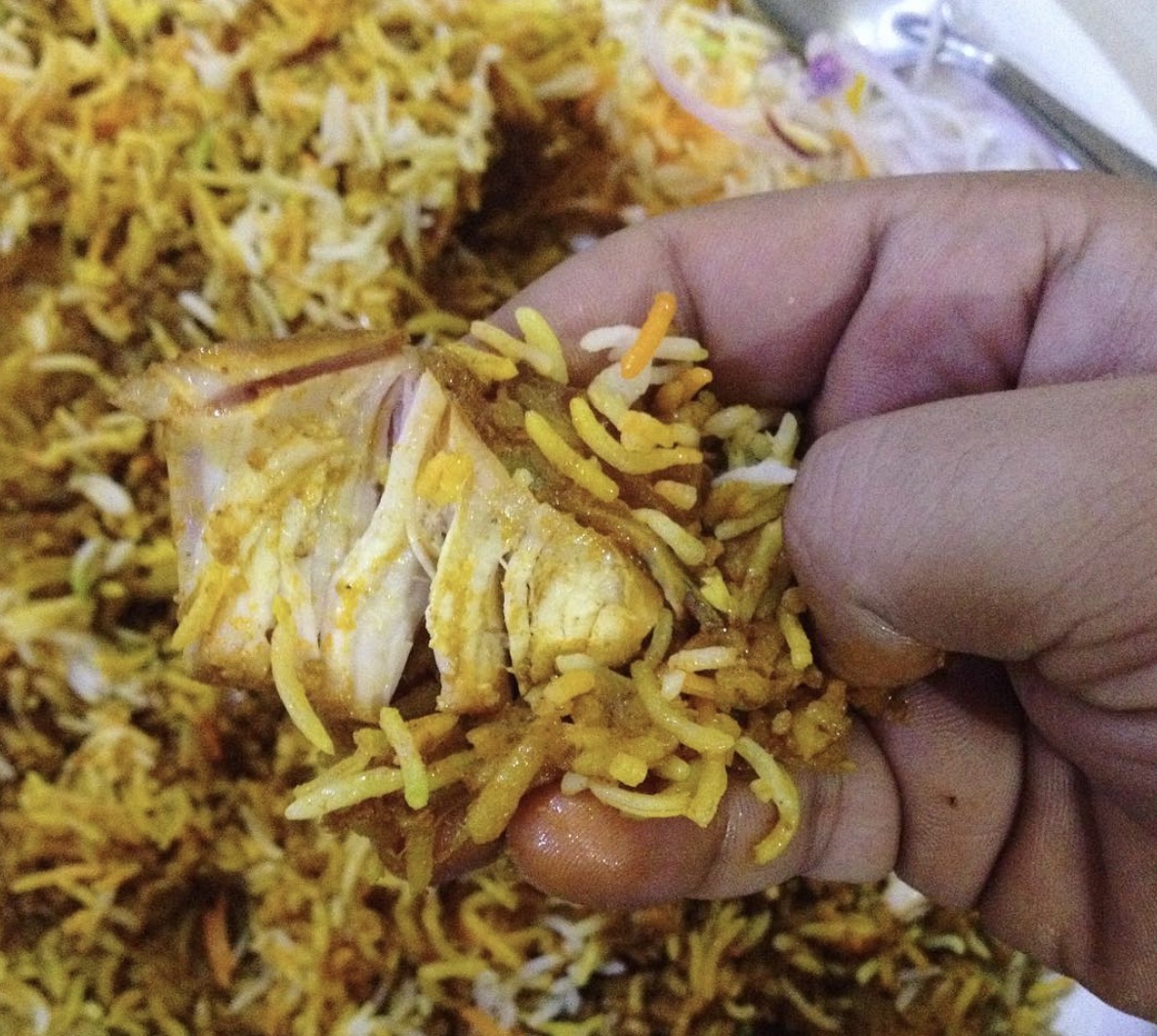
There comes a point near the end of every serious plate of biryani when I stop merely eating and begin conducting an inventory. There is still plenty of rice, but only one important piece of meat remains. A little masala has collected underneath it, one slice of onion is resting near the edge of the plate, and the lemon has enough life left for one final squeeze. Everything necessary for a magnificent ending is present, but it has to be protected from poor planning, an inaccurate estimate of the rice or, most dangerously, somebody else’s hand.
The piece of meat is the centre of the operation. If there is a juicy seam of fat attached to it, even better. I begin eating around it, reducing the excess rice while preserving enough masala to carry the final mouthful. The onion cannot be consumed prematurely, and the lemon cannot be exhausted on a lesser bite. By the time I reach the end, I want my five fingers to gather and roll the rice into their embrace with the meat, masala, fat, onion and acidity held in perfect proportion. The flavours should arrive together with enough force that the meal does not simply stop because the plate has become empty; it should end on a crescendo.
The perfect last bite begins long before the last bite. It is not something you happen to find waiting at the bottom of the plate, because most meals are not considerate enough to arrange themselves so conveniently. It has to be engineered through a sequence of small decisions that become increasingly important as the available food diminishes. You eat a little more rice because the current meat-to-rice ratio is unsustainable. Or, in a crazier world, you eat more meat to catch up with the quantity of rice. You tear a smaller piece of roti because there is not enough gravy to support your preferred levels. You preserve a little pickle, move the onion somewhere safe and periodically reassess the entire situation.
To anyone watching, you are only eating lunch. Internally, however, you are managing resources.
This is particularly evident when I eat anything containing paneer, chicken, meat or boiled egg. There is nearly always one piece that becomes the pièce de résistance, and once I have identified it, the entire meal begins reorganizing itself around its survival. It may be the piece of paneer that has remained especially soft or has been seared to perfection with brown, crusty edges; the section from the side of a chicken leg that comes off in one perfectly tender chunk; the meat with a little juicy fat; or the boiled egg that has somehow absorbed the flavour of the curry without losing its own mild, distinct pleasure. That piece is no longer simply another component of the dish; it has acquired a future.
This does not mean that all pleasure must be postponed. If there are enough good pieces, a meal deserves a great beginning as much as it deserves a great ending. One piece of meat can announce what is ahead, while another waits to conclude it. The opening bite establishes confidence. It reassures you that lunch is going to be good and that the cook has done right by you. Once that has been confirmed, the meal can proceed more casually, held between those two important points like a story with a beginning already written and an ending carefully reserved.
The danger, of course, is that anything deliberately reserved becomes vulnerable.
Childhood with siblings teaches you this very quickly. A piece left untouched on a plate may look unwanted to someone who has not been informed that you have constructed an elaborate emotional future around it. You may know that the piece is being saved, that the remaining rice is being measured against it and that the onion beside it has already been assigned a supporting role, but to a sibling it can appear to be unattended meat. Or, in their words, “I thought you did not want it.”
This is why the final piece must be guarded. You keep it close, make its ownership physically obvious and remain alert to any stray hand moving toward the plate. There is no pain quite like watching somebody nick the piece with which you had such dearly held plans. The meal may still contain enough food, and another piece may even be available, but that is irrelevant.
They have not merely taken some meat. They have destroyed an ending. That shit hurts more than heartbreak because heartbreak, at the very least, does not usually leave you with three unsupported mouthfuls of rice.
One of my clearest childhood versions of this involved the boiled egg in anda curry. I would preserve it until the end because I enjoyed gradually clearing away the gravy that clung to its surface and then savouring the egg itself. The curry had already flavoured everything around it, but the egg offered a soft, quiet conclusion beneath all that spice. Saving it gave the entire meal direction. Every roti torn and every mouthful taken moved me closer to the egg, provided nobody interfered with the plan.
This instinct is not limited to Indian food, and once you begin watching for it, you can see versions of the same arithmetic everywhere. Someone eating a burger works their way around it so the perfect centre bite remains untouched, or eats a sandwich as if pushing chess pieces into position to reach the perfect bite. Someone eating pizza decides whether the crust is a reward, an obligation or an otherwise unacceptable ending that must be coated in enough dipping sauce. A person eating a layered dessert digs strategically so the final spoon contains cake, cream, fruit and crunch rather than the residue of whichever component was supplied too generously. Even people who insist that they simply eat what is in front of them often reveal preferences about which part should remain when everything else has disappeared.
What interests me is that we rarely describe any of this as planning. The calculations have become too embodied to feel intellectual. Just as nobody notices air, these subtle human instincts are rarely considered or written about. Nobody produces a formal assessment of the plate and determines that precisely seventeen grams of rice must be removed before the remaining meat can be deployed. The eye notices imbalance, the fingers adjust, and the mouth already knows what kind of ending it is trying to reach. It is a small form of intelligence located somewhere between appetite and muscle memory.
This intelligence becomes most visible when the calculation goes wrong. Occasionally, I arrive near the end and discover that I have preserved too much of something. In that case, the excess must be eaten without support so that the final composition can remain precise. A few spoonfuls of rice may have to be consumed with inadequate gravy, or some bread eaten without the meat it deserved. These are sacrificial bites. They accept a temporary reduction in pleasure to protect the conclusion.
The opposite error requires diplomacy. If there is not enough roti left, I look around the table and determine whether someone might be willing to share half of theirs. If the rice has run dangerously low, I can ask my mother for a niwala—not a complete serving, only enough rice to restore the intended proportion. These are small negotiations, but they reveal how much social activity can gather around a bite that will exist for only a few seconds. Someone else has to understand that you are not still hungry in the ordinary sense. You are requesting structural assistance.
There is only one failure that is not easily repaired: constructing the perfect final bite and then realizing there is no onion left to chase it.
I have already written about the small things that sit around an Indian meal waiting for the particular mouthful that needs them—the onion, lemon, chilli, pickle, cucumber and other forms of culinary mischief that allow the eater to give one bite a little more flair than the previous one. In “Tujhko Mirchi Lagi Toh Main Kya Karu”, I called them chasers because they often appear with or immediately after a mouthful, delivering sharpness, acidity, heat or relief.
The final bite is where their absence becomes tragic. You have protected the meat, corrected the quantity of rice, preserved enough masala and executed the lemon squeeze beautifully, only to discover that you ate the last onion slice several minutes ago. The bite itself may be perfectly assembled, but it has no punctuation. Cutting an entire onion for one final slice is not usually feasible, so you finish knowing that the composition came painfully close to greatness.
This may explain why the final bite can become disproportionately large. I already enjoy large mouthfuls, something my wife would readily confirm, but the last one occasionally grows beyond even my ordinary ambition because I have miscalculated. Too much rice remains, the meat cannot be divided without diminishing its importance, and all the components I have preserved must now fit into a single bite. At that point I am no longer creating elegance; I am attempting to honour several previous commitments simultaneously. The mouthful becomes enormous because abandoning any of them would not feel right.
There is something deeply optimistic about saving the best for last. It requires the belief that the desirable thing will remain yours while you attend to everything else. Childhood sibling rivalry complicates that belief by introducing surveillance, defensive plate positioning and the possibility of sudden theft, but it does not eliminate it. If anything, it makes the preservation more deliberate. You protect the piece because you have imagined a future with it.
Perhaps that is why a disappointing final bite can alter the memory of an otherwise good meal. The ending is the flavour that remains after all the others have become recollection. When the ratios are right, the final mouthful gathers the argument of the meal into one place: the richness of the meat, the comfort of rice, the concentration of masala, the sharpness of onion, the brightness of lemon and the satisfaction of having brought them together deliberately. It is not necessarily the objectively finest bite on the plate, but it carries the additional pleasure of fulfilment. Something went according to plan.
Most of the time, that is enough to end the meal. The last bite is swallowed, the spice remains in my mouth, and the experience feels complete. At other times, however, I remember that I am my nana’s grandson, and an empty plate does not necessarily mean that the mouth has agreed to stop.
Japanese has a useful expression, kuchisabishii, which describes a mouth that feels lonely or still longs to have something in it even when hunger is no longer the reason. I know that feeling particularly well after a Gujarati meal. Sometimes it is answered by my mother’s homemade mukhwas, made with flaxseeds, dhana dal, fennel and sesame, all roasted with salt and turmeric. It changes the flavour of the mouth completely, replacing the meal with something aromatic, nutty and gently savoury.
On other occasions, subtlety has no appeal, and I resort to what we call faka maarna: pouring a little teekhi Ratlami sev into the hand, tilting the head back and throwing the whole thing directly into the mouth. I am not hungry, nor am I trying to improve the meal that has already ended. I simply want the spice to linger. My stomach has finished eating, but my mouth would like the experience to continue for a few moments longer.
Perhaps that is what all this careful rationing is ultimately trying to control. Hunger tells us when to begin, but our instincts want us to reach a satisfying conclusion. We arrange that ourselves through preserved pieces, corrected proportions, borrowed rotis, guarded eggs, reserved onions and bites that occasionally become too large for our own good.
The plate can become empty by accident, but the perfect last bite allows the meal to feel finished. Sometimes love extends the meal further still, when you assemble that perfect bite and feed it to someone besides yourself.