A friend had been trying to convince me to move my writing to Substack for years. Technically, I already did. I opened one, published three posts, looked around for a little while, and then abandoned it almost as quickly as I had arrived. By then everyone seemed to be moving to Substack. Writers I followed were there, journalists were there, people leaving newspapers were there, people who had never worked for newspapers were there, and eventually the inevitable happened: people started announcing their new Substacks with the same solemnity with which people once announced podcasts.
I would be lying if I said that did not put me off a little. There is some petty part of me that become uninterested of anything the moment everybody starts doing it. I can admit that. But that was not really why I left.
I left because somewhere over the past few years I realized that I have lost almost all faith in the idea of building anything important entirely inside somebody else's platform.
The problem is not Substack specifically. I do not have some particular grievance against the company, and for writers who want to start publishing without thinking about domains, hosting, newsletters, website design or the other administrative debris that mysteriously attaches itself to the simple desire to put words in front of people, it is an extraordinarily useful product. The problem is that Substack is still a company, and if I spend twenty years putting my life's writing there, then some portion of the continued existence of that life's work depends upon decisions being made in rooms I will never enter by people I will never meet.
We have somehow become accustomed to this arrangement.
We buy films without owning films. We buy music without possessing music. We put photographs of our children, weddings, dead relatives, first apartments, terrible haircuts and entire decades of our lives inside accounts belonging to corporations. Writers build careers inside publishing platforms. Musicians build audiences inside streaming services. Businesses build their entire relationship with customers through Instagram. Then everybody behaves vaguely surprised whenever one of these companies reminds us that the relationship was never between equals.
On September 1, 2026, PlayStation users in affected markets lost access to a catalogue of StudioCanal films they had previously purchased. Sony's own notice is remarkably plain about it: because of content licensing agreements, customers would no longer be able to access their “previously purchased content,” and those titles would be removed from their video libraries.
There is something almost perfect about the phrase previously purchased content. Purchased is such a comforting word. It belongs to the older vocabulary of possession. I purchased a book, therefore the book is on my shelf. I purchased a saucepan, therefore barring burglary or an exceptionally hostile roommate, the saucepan continues being mine. Yet we have imported that same language into transactions where what we frequently purchase is not the thing itself but a revocable system of access to it.
Amazon does not particularly hide this. Prime Video's terms describe purchased digital content as being provided under a non-exclusive, non-transferable, limited licence. The same terms say that purchased content will generally remain available but may become unavailable because of licensing restrictions or other reasons, and that Amazon will not be liable if that happens. A federal case against Amazon has dealt directly with the strange distance between the word “Buy” displayed to consumers and the limited licence described deeper inside the contractual relationship.
That is such an extraordinary linguistic trick that we barely notice it anymore. We use the vocabulary of ownership for the experience of access.
The distinction matters even when nobody deliberately takes anything away. In August 2026, a Google user reported losing access to digital copies of the extended editions of The Lord of the Rings that they had purchased years earlier. Google eventually said the problem was technical rather than an intentional revocation and issued store credit, although the customer reportedly continued having trouble accessing parts of the library. In some ways I find that explanation more unsettling, not less. Nobody had to decide that this person should lose their films. A sufficiently complicated collection of databases, licences, applications and authentication systems merely stopped behaving in the way a purchase was supposed to behave.
That is the part of digital life I increasingly distrust. My possession of something can depend upon a server correctly recognizing that I possess it.
The company does not even need to become malicious. It does not need a villainous chief executive sitting in a glass office deleting my essays individually while lightning strikes outside. It can simply change.
It can be bought. It can run out of money. It can decide that the product I use is no longer strategically important. It can redesign itself around something entirely different. It can decide that video matters more than text, or advertising matters more than subscriptions, or artificial intelligence matters more than both. It can be technically mismanaged. It can slowly become culturally irrelevant until one day keeping the servers running is more expensive than shutting them down.
We already watched enormous online worlds become ruins. MySpace did not merely lose cultural relevance. In 2019 it emerged that a failed server migration had resulted in the loss of content uploaded before 2016, including photographs, videos and tens of millions of songs, some of which had no other home on the internet. People had treated the platform as an archive, and then discovered that an archive controlled by somebody else can become a deletion event.
Orkut disappeared. MySpace became a relic. Twitter became X and transformed dramatically under new ownership. Websites that once felt permanent now survive mostly as screenshots and memories of what the internet used to look like.
That is what frightened me about moving all my writing to Substack.
It was not that Substack had become uncool because everyone suddenly had one. I can survive the terrible indignity of being interested in something popular. What bothered me was the thought that I might spend the next thirty years writing there and eventually discover that I had mistaken a platform for a home.
An audience is not a home.
That distinction is why I finally built my own website.
I had owned the domain for years, intermittently tinkering with versions of the site, abandoning them, rebuilding them, changing my mind about what it should look like and generally demonstrating why entire professions exist to prevent writers from becoming their own web developers. But eventually the website stopped feeling like a vanity project. It became infrastructure.
The writing needed an address that belonged to me.
My website still depends on a frankly ridiculous tower of other technologies. There is a domain registrar. There is Cloudflare. There are servers and databases. There are DNS systems translating names into addresses. There are cables carrying information across continents and underneath oceans. Somewhere there is an actual physical machine using actual electricity so that you can read an essay that appears on your screen as though it materialized effortlessly from something we romantically call “the cloud.”
The cloud is one of our better pieces of technological marketing because it sounds wonderfully immaterial.
It is not.
The cloud is buildings.
It is racks of computers, cooling systems, power supplies, backup generators, fibre-optic cables, network switches, technicians, contracts and enormous amounts of electricity. The internet feels weightless only because most of its physical machinery is somewhere we cannot see.
I sometimes joke that my allegedly permanent digital life ultimately depends upon fibre-optic cables lying on the ocean floor waiting for a shark thinking it is a Sea-kh kebab. The reality is less cinematic. Undersea cables are far more often damaged by anchors, fishing activity and ordinary mechanical failures, and the global network contains enormous amounts of redundancy. A solar flare is unlikely to simply erase civilization's hard drives in one magnificent afternoon.
But the joke contains something I think we have forgotten.
Digital does not mean immaterial, and immaterial does not mean permanent.
So building the website is only the first step.
The next thing I want to build is a library.
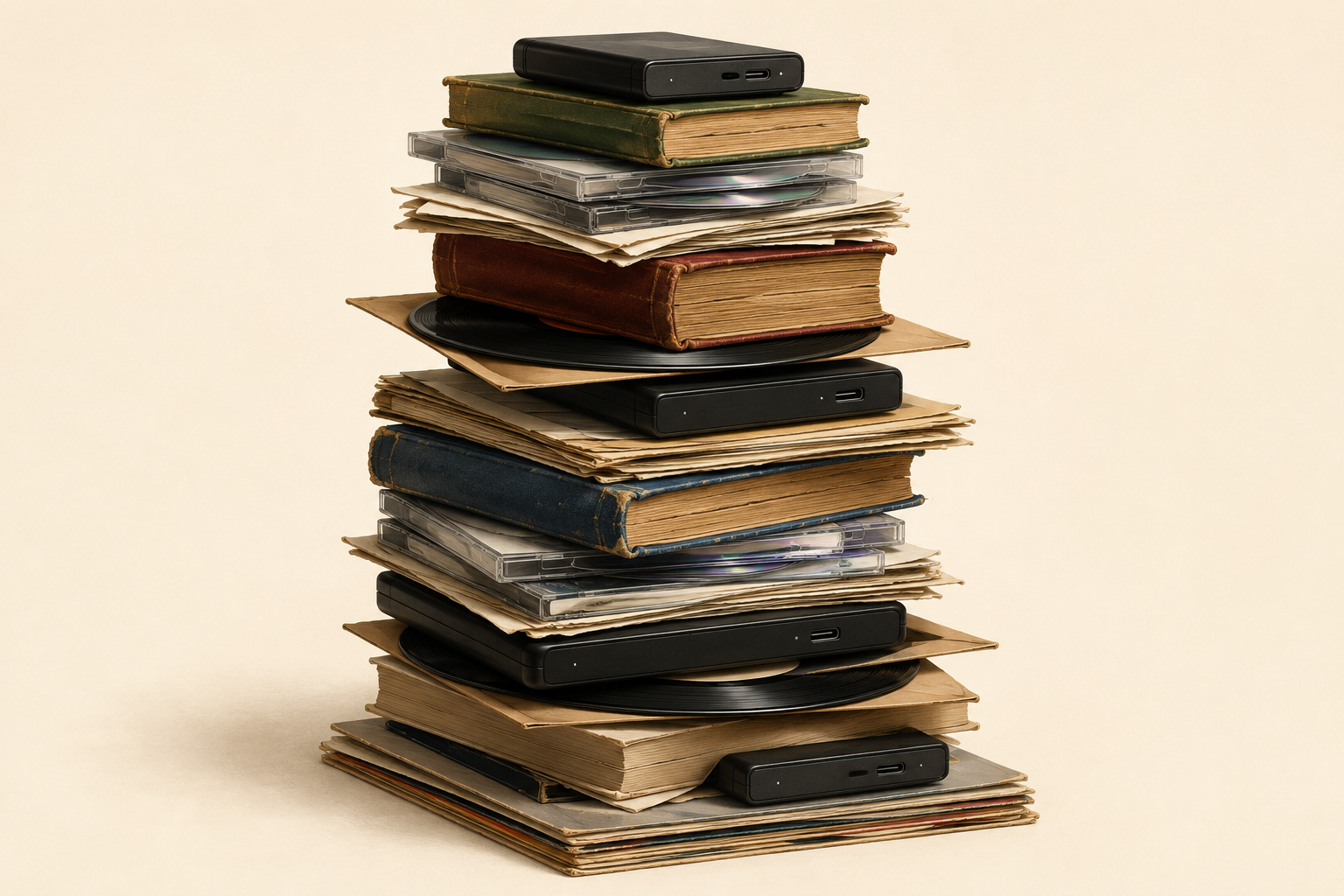
I mean library in the older, almost embarrassingly literal sense of the word. Shelves. Books. CDs. DVDs and Blu-rays. Photographs. Printed copies of things that matter to me. Objects whose continued existence does not require my account to authenticate successfully.
But I do not want to abandon the convenience of the digital world either. Nostalgia is not very useful if its solution to Spotify is making me carry a Discman and a folder containing seventy-two CDs onto an international flight. What I want is the property of physical ownership combined with the extraordinary accessibility digital technology gave us.
That is where the NAS comes in.
Over time I want my own drives and eventually my own server at home, a personal archive that contains my writing, photographs, documents, music and the media I am legally able to preserve there. I want the things that matter to me to exist physically somewhere I can point to, while still being accessible to me when I am travelling halfway across the world.
If I buy a CD, there is a disc.
If I buy a book, there is a book.
If I own photographs, there are copies on drives I control.
If I spend forty years writing essays, there are files that continue existing regardless of which publishing company is fashionable when I am sixty.
The point is not to replace one supposedly permanent system with another. Hard drives fail. Servers fail. Discs can be scratched. Houses can flood or burn. Websites disappear. Domains expire because somebody forgets to renew a credit card. Anyone who has ever owned a computer knows that technology displays a peculiar enthusiasm for dying immediately before something important has been backed up.
The answer is redundancy.
The website is one copy.
My computer is another.
The NAS is another.
A separate backup is another.
The printed object may be the best.
The mailing list should be exportable. The writing should exist independently of the software currently displaying it. The domain should be portable. The archive should be capable of surviving the death of any individual service that happens to sit between me and the reader today.
Nothing important should exist in only one place, especially when that place belongs to somebody else.
I think this is the bargain we gradually stopped noticing as the internet became more convenient. For decades technology companies correctly identified almost every irritating feature of ownership. CDs take up space. DVDs have to be stored. Photographs have to be organized. Hard drives have to be backed up. Websites require maintenance. Music collections have to be carried around. A shelf full of movies is considerably less convenient than typing three letters into a search bar and pressing play.
The trade was often worth making. I am not interested in pretending otherwise. Streaming music has allowed me to hear artists I would never have encountered in a record shop. Cloud storage lets me open a document in another country within seconds. The web allowed me to publish an essay to readers around the world without asking an editor, printer, distributor or bookseller for permission. These are astonishing things.
I just no longer think convenience should require surrendering the source.
That is the philosophy I am slowly arriving at: own the source and rent the convenience.
Remember everyday you walk on ruins of empires that once thought they are immortal. The roman empire eventually crumbled over the centuries. The entire internet is not even 50 years old and you are already seeing major cracks and failures in it all the time.
Use Spotify for discovery, but own the music you cannot bear to lose.
Use streaming services, but keep physical copies of the films that matter enough to you.
Use cloud storage, but keep local copies of your photographs and documents.
Use social media to find readers, but do not let the social network become the only place those readers can find you.
Use whatever newsletter platform is useful, but keep your subscriber list exportable.
Use Cloudflare, hosting companies, databases and all the miraculous machinery of the modern internet, but structure things so that if one disappears you have lost a service rather than a life.
And publish on your own domain.
I suspect that is why building my website felt more significant than it reasonably should have. I had not simply designed a nicer place to put essays. I had started separating the work from the platform carrying it.
The physical library and the server will come next. There will be shelves and drives, probably too many cables, multiple backups, a machine humming somewhere in the house and an inevitably overcomplicated system that I will insist is completely reasonable because humans apparently become very strange once they discover network-attached storage.
But somewhere inside all of that will be my work.
Not merely a username.
Not merely an account.
Not merely permission to access something for an indefinite period subject to somebody else's terms.
A copy.
And somewhere else, another copy.