
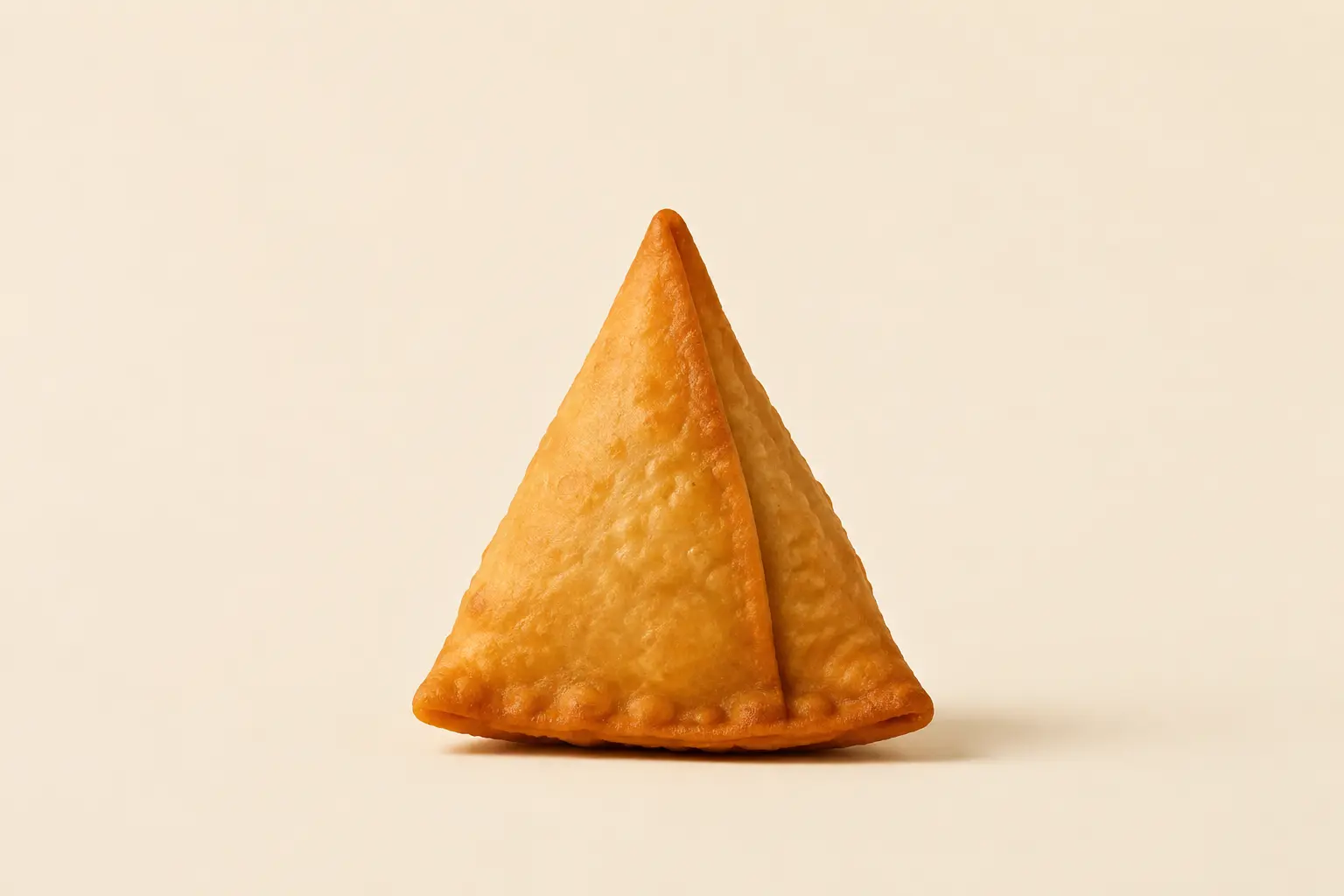
India loves a grand phrase. Unity in diversity is one of them—printed in textbooks, delivered in speeches, repeated until it risks meaning nothing.
In Vadodara, you can understand it more easily by eating four samosas.
Within a few kilometres, the same triangular idea changes its pastry, filling, size, accompaniments, customers and even the hour at which it appears. The triangle stays. Everything else negotiates.
Raju Patti Samosa
At Raju, the samosa begins with the pastry.
This is not the thick, khasta shell most people picture. It is made with patti—a sheet as thin as filo that fries into something delicate and shattering. Inside is a sharp filling of potato and raw onion, with enough spice to make itself known before you have finished the first bite.
There are no bowls of chutney and no elaborate supporting acts. Just the samosa and a fried green chilli.
It is crisp, hot and direct. Two bites, perhaps three, and then your hand is already reaching for another.
Manmohan Samosa
At Manmohan, the samosa gains weight.
The crust is khasta: flaky, rich and almost shortcrust-like. The samosa itself is considerably larger, filled with tiny cubes of potato rather than a uniform mash. Coriander, cumin, black pepper and black salt give it a more distinctly North Indian temperament.
Then comes the presentation.
The samosa is covered with ragda, onions and sweet chutney until it stops behaving like a snack and becomes an entire plate of chaat. Sweet, sour, salty, spicy and rich all begin crowding one another for attention.
It is large enough to count as lunch—and, according to the businessmen nearby, large enough to rescue a man from the karela waiting inside his tiffin.
Gupta Samosa
In Fatehgunj, Gupta occupies the space between restraint and indulgence.
Its crust is khasta like Manmohan’s, but the samosa is smaller and easier to eat on the move. Instead of covering it with ragda, the vendor presses a small crater into the centre and fills it with spicy chutney and fried chillies.
The filling is mashed rather than diced, riddled with white peas and sharpened with ginger and green chilli paste. Without ragda to soften the blow, it packs a proper punch.
It is not a ceremonial plate of street food. It is a quick, aggressive snack for university students, workers and personnel from the army barracks down the road. The samosa has adapted to the people walking past it.
Rafiq Samosa
The fourth samosa appears only after Maghrib.
Rafiq works from a small pushcart, making tiny patti samosas that can disappear in two bites. But inside the delicate shell is minced buffalo meat, seasoned with garam masala, fresh mint and onions.
Then comes the smoke.
Charcoal gives the meat a deep aromatic edge that hangs behind the spice. The contrast is beautiful: brittle pastry outside, warm fat and smoke within.
You can also visit Rafiq’s home and buy the samosas raw. Fry them yourself, add green chutney and onions, and press the whole thing between a bun. A samosa becomes a sandwich without ever ceasing to be a samosa.
There is something fitting about the meat filling. The potato samosa we now treat as the default is itself an adaptation. Earlier relatives of the samosa travelled to the subcontinent from Persia and Central Asia, often filled with meat, nuts and dried fruit. Potatoes arrived centuries later and were absorbed so completely that today we struggle to imagine the samosa without them.
Rafiq’s version is not a deviation from an authentic original. It is proof that the original never stopped moving.
The Triangle Is the Only Constant
These four vendors are not merely selling different fillings. They are making four arguments about what a samosa can be.
Raju is pastry and heat. Manmohan is abundance. Gupta is speed and sting. Rafiq is smoke and meat.
One shatters. One flakes. One is opened and flooded with chilli. One is slipped between bread. They appear in different neighbourhoods, serve different appetites and belong to different moments of the day.
The triangle is the only constant.
That is the real unity in India’s diversity—not sameness, and certainly not purity, but a form sturdy enough to absorb migration, neighbourhood, class, habit and appetite without losing its name.
Unity in diversity can sound like a phrase from a school textbook.
In Vadodara, it leaves oil on your fingers and makes you order one more.