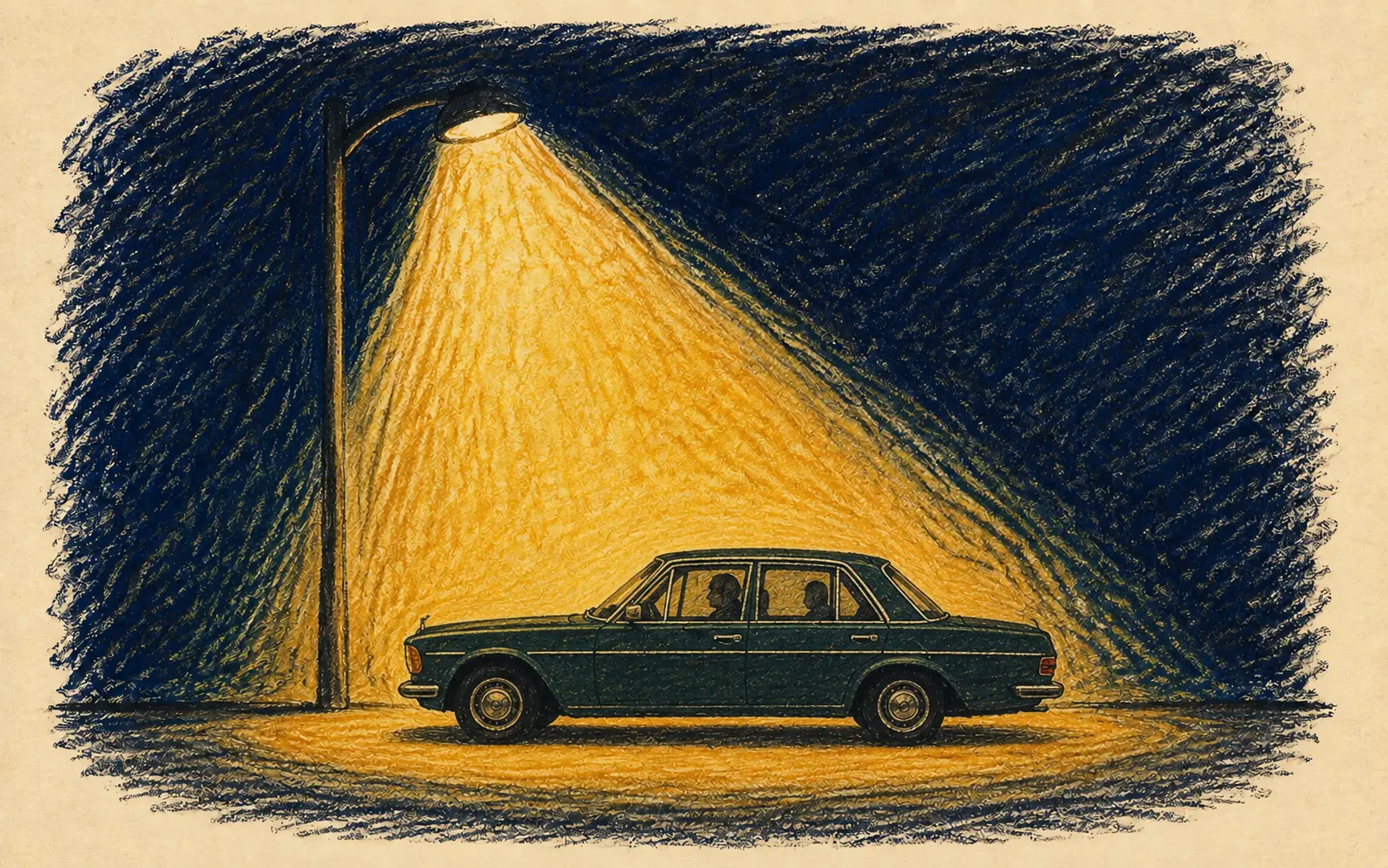
It was eleven at night when I left work.
The road home was fifty-five kilometres of mostly straight highway. It was dark. I was tired, but not agitated. It was the particular kind of tiredness that makes you want company without conversation.
So I put on Umm Kulthum.
Alf Leila wa Leila began as I pulled out of the parking lot. I had chosen it deliberately. Nobody else was in the car, which meant nobody else had to suffer through my musical curiosity, and the road demanded just enough attention to keep me present without taking me away from the song.
For a very long time, Umm Kulthum did not sing.
The orchestra took possession of the road first. Strings rose and withdrew. Instruments introduced themselves, disappeared and returned. The music did not seem particularly concerned with whether I was impatient. It assumed that if I wanted what was coming, I would wait.
Then her voice arrived.
The song ended as I pulled into my driveway.
I sat for a moment with the peculiar satisfaction of having completed a journey twice: once across fifty-five kilometres of Ontario highway, and once through a song that had asked for almost the same amount of time.
Who, in their right mind, listens to a forty-minute song in a language they do not completely understand? Who listens to a performance in which the singer can take what feels like half the journey simply to begin singing?
Arab dads, apparently.
Before I began listening to Umm Kulthum, I saw a meme of an Arab father sitting in a parked car. Umm Kulthum had started playing on the drive home, his teenage child explained, and now the father would remain there until the entire song was over.
It did not make me laugh. It made me curious.
There must be something in this music, I thought, that makes a person unwilling to interrupt it even after arriving home. Something powerful enough to turn a driveway into a concert hall and a parked car into an inheritance.
The image made me nostalgic for something I had never experienced. I wanted to sit inside that car. I wanted to know what the father knew. I wanted to hear what the Arab dads hear.
Fairuz came first.
I encountered her on shuffle while listening to Sherine, and then encountered her again through memes comparing different Fairuz songs to different stages of transcending the universe. That seemed like as good an invitation as any.
I had already begun trying to learn Arabic. Listening to Fairuz felt like a way of immersing myself in the language, but very quickly it went beyond language study. I was no longer listening to identify vocabulary. I was listening because I wanted to return.
Fairuz will probably be my most-played artist on Spotify this year.
Eventually, I developed a system.
Short drive: Fairuz.
Long drive: Umm Kulthum.
This is not because Fairuz is somehow smaller. The two women alter time differently.
Umm Kulthum transports me into a concert hall filled with warm light. I imagine men in their nicest suits, drops of sweat gathering on their foreheads, leaning towards the stage because sitting upright is no longer sufficient. Her music is public even when I am hearing it alone. She summons a room around herself.
Fairuz is more intimate. She transports me to Lebanon as though she is showing me around her neighbourhood. Sometimes she is walking beside me. Sometimes she is sitting across from me, telling me about an old love. Sometimes she is pointing towards a house, a street or a city and asking me to understand what used to be there.
Umm Kulthum is sustained collective ecstasy. Fairuz feels like talking to a friend.
But beneath that difference, they move me through the same elements: love, longing and loss. Especially longing. So much longing that even before I read a translation, I can usually tell which emotional country we have entered.
I did not arrive at this music entirely untrained.
Nusrat Fateh Ali Khan had already taught me how to wait.
Listen to Piyala Rakh De Ik Paase. Or listen to a live ghazal by Ghulam Ali. South Asian music has many ways of telling you that repetition is not redundancy. A line is not repeated because the singer has run out of lines. It returns because it has not finished revealing itself.
The words may remain the same, but the sentence is emotionally rewritten each time. A syllable is stretched. An inflection changes. The singer approaches the same thought from a new direction and discovers that it contains another room.
This is musical patience, but patience is perhaps the wrong word. Patience sounds like tolerating a delay before receiving the thing you actually wanted. In these performances, the delay is part of what you wanted. The anticipation is not an obstacle to pleasure. It is how pleasure acquires weight.
All art that refuses to rush gratification understands this.
A very good long song can work like very good sex. It is built up and foreplayed. It is felt, fucked and understood. It slows, hastens, withdraws and returns. It reaches a crescendo and then, importantly, does not abandon you there. It brings you down gently, with soft kisses along the back.
Contemporary music often behaves as though it is terrified we might leave. The hook must arrive immediately. The chorus must reveal itself before our thumb can reach the next song. Every silence is treated as a place in which the audience might become bored.
Umm Kulthum does not appear worried that you might become bored.
She knows what is coming.
More importantly, the audience knows too.
There is an Arabic word often associated with performances like hers: tarab. It is commonly translated through words such as ecstasy, enchantment or musical rapture, but none of them quite holds the whole experience. Tarab is not merely an emotion delivered by a singer to a passive listener. It is something created between the singer, the musicians and the people in the room.
Umm Kulthum’s audience did not simply witness her performances. They helped shape them.
They called out. They praised. They demanded returns. She repeated lines in response and changed them as she did. A composition that might have occupied twenty minutes could expand enormously in performance because the room had become part of the music. This is why the live recordings matter. The crowd is not noise left behind by imperfect recording technology. The crowd is one of the instruments.
In Alf Leila wa Leila, Umm Kulthum can spend an extraordinary amount of time on only a handful of lines. Then a voice erupts from the audience in praise.
I do not need to understand every word of the interruption to understand what has happened. The man heard what I heard. Something in that phrase landed. His shout confirms that the feeling was not a fluke.
I recognize this relationship.
I have heard it in recordings of Nusrat Sahib, when someone in the audience cries out because a line has found the exact location of an old wound. I have heard it with Ghulam Ali, when appreciation escapes before decorum can contain it. In qawwali, the distance between artist and audience is already unstable. Feeling travels in both directions.
So when Umm Kulthum’s audience speaks, they become my first translators.
They tell me where the sentence opened.
They tell me when an old word became new.
They tell me that whatever I felt in the silence after ya habibi, somebody in that room felt it too.
My Arabic remains fragmentary. I know ana. I know ya habibi, ya zaman, hayati. I catch words before I catch sentences. I hear Fairuz ask kifak inta and understand the question before I understand everything surrounding it.
But Arabic has never sounded wholly foreign to me.
It sounds like home, memory, childhood, prayer and plea.
I am Muslim, and therefore some of my earliest relationship with Arabic comes through faith. It carries the comfort of recitation and the physical memory of prayer. But Arabic is not a Muslim language. It never has been. Fairuz, a Christian woman singing in Arabic, should be an obvious reminder of this, though it may still be a necessary one for many listeners.
Arabic belongs to everyone whose mothers have comforted them in it, everyone who has argued in it, flirted in it, prayed in it, written poems in it and called someone habibi without needing to translate the word first. It belongs to mosques and churches, to scripture and street corners, to lovers and revolutionaries, to the faithful and the faithless.
Fairuz allows all of those meanings to occupy the same voice.
When I finally read translations, they do not correct an empty interpretation. They make the feeling more profound. I discover that the longing I heard really was longing, though it carried histories and particulars I could not have known from sound alone.
This is why I resist the easy claim that music simply transcends language. It makes the encounter sound magical and effortless. It was not effortless. Curiosity brought me here. I stayed. I listened repeatedly. I learned names, histories and contexts. I began recognizing words. Then I returned to the songs and heard more.
The deliberate pursuit of other cultures is, for me, a way of life.
Not the consumption of their most convenient products. Not collecting dishes, songs and phrases as evidence of being worldly. I mean the pursuit of enough understanding that another person’s references begin to acquire weight. Their jokes become funny for the right reasons. Their grief is no longer generic. A song playing in a restaurant stops being atmospheric “foreign music” and becomes a song with a name.
There is no way to separate Umm Kulthum and Fairuz from the histories that made them cultural institutions.
For almost four decades, Umm Kulthum’s Thursday-night concerts were broadcast live across Egypt and the Arab world to audiences numbering in the millions. Her voice entered cities, villages, cafés, homes, tents and political life. She became associated not only with Egyptian music but with Egypt itself. After the 1952 revolution, she sang for the new republic. After Egypt’s defeat in the 1967 war, she toured and raised money for the country. Her audience did not merely listen to history through her. They lived portions of that history with her voice already in the room.
Fairuz’s career became similarly inseparable from Lebanon. She sang of villages, mountains, mornings, love, Jerusalem and Beirut. During the Lebanese Civil War, she refused to perform inside Lebanon rather than allow her presence to be claimed by one side, while continuing to perform abroad. That refusal was not an absence of politics. In a country being divided into territories and factions, refusing to let one faction possess her became its own political act.
Her restraint allowed people separated by politics to continue recognizing the same voice.
This is why calling these women singers feels insufficient. A singer performs songs. A cultural institution stores memory.
When Fairuz sings of Beirut, I do not turn her city into a metaphor for my own comfortable sadness. I think about people who were physically separated from their homes throughout Lebanon, Palestine and the wider Arab world. People whose relationship with a street, village or country was severed by war, occupation, sectarian violence and foreign intervention. People who carried keys, photographs, recipes and songs because the place itself had been taken from them or made impossible to return to.
I know that history. But the voice transports me into its emotional climate.
My own family history gives me only a small point of recognition, not an equivalence. After the 2002 violence in Gujarat, my father wanted my brother and me to leave India. He had seen politics change enough to fear physical danger for his sons simply because we were Muslim. We were not forcibly displaced. We did not flee with only what we could carry. The distinction matters.
But I grew up knowing that a father could love a country and still decide that his children might be safer elsewhere.
Perhaps that is why songs addressed to cities do not sound sentimental to me. A country is not an abstraction when someone has had to calculate whether it will protect their children.
Still, I am writing this as a cultural outsider.
I do not have Arab parents who played Fairuz in the morning. I do not have grandparents who arranged their first Thursday of the month around Umm Kulthum’s broadcast. I have no inherited story about where the family was when a particular performance aired. My relationship with these women began with a shuffle playlist, internet memes and long drives through Ontario.
I arrived through curiosity.
But curiosity, practised seriously, can become a form of recognition.
Now, when Fairuz plays in a shawarma shop, I know her voice. Sometimes I know the song. Sometimes I catch the words. There is a small, private satisfaction in realizing that the music has stopped being anonymous to me.
The room has become slightly less foreign.
And when I see the Arab father refusing to leave his parked car because Umm Kulthum is still singing, I no longer wonder what could possibly keep him there.
I get it.
I understand why the car cannot be turned off. I understand why a forty-minute performance cannot be reduced to its most beautiful five minutes. I understand why a repeated line is not the same line. I understand why Fairuz can sound like a childhood, a neighbourhood and a country at once. I understand how two women can become places people return to.
I understand what the Arab dads hear.
For everyone else, I have a request.
Listen to Fairuz’s Wahdon. Then listen to Umm Kulthum’s Alf Leila wa Leila.
Do not look up the translations first. Do not skip the instrumental opening. Do not clean the crowd out of the recording in your mind. Let them shout. Let the line return. Let yourself become impatient, and then remain long enough to discover what waits on the other side of impatience.
When it is over, write back to me.
Tell me what you thought they were saying before you knew.