Slaughtering an animal has always been an event.
I say this after seeing two cultures that look completely different on the surface perform essentially the same act: one in Louisiana, and one here at home in India.
There is a gathering the day before. Uncles, distant cousins, friends and everyone in between arrive at the house and share stories about what has been happening in their lives. There is joy and sorrow alike. Good news is celebrated. People who are no longer with us are remembered.
Family gathers, and very little remains hidden.
The next morning, after the rituals are complete, the animal is slaughtered.
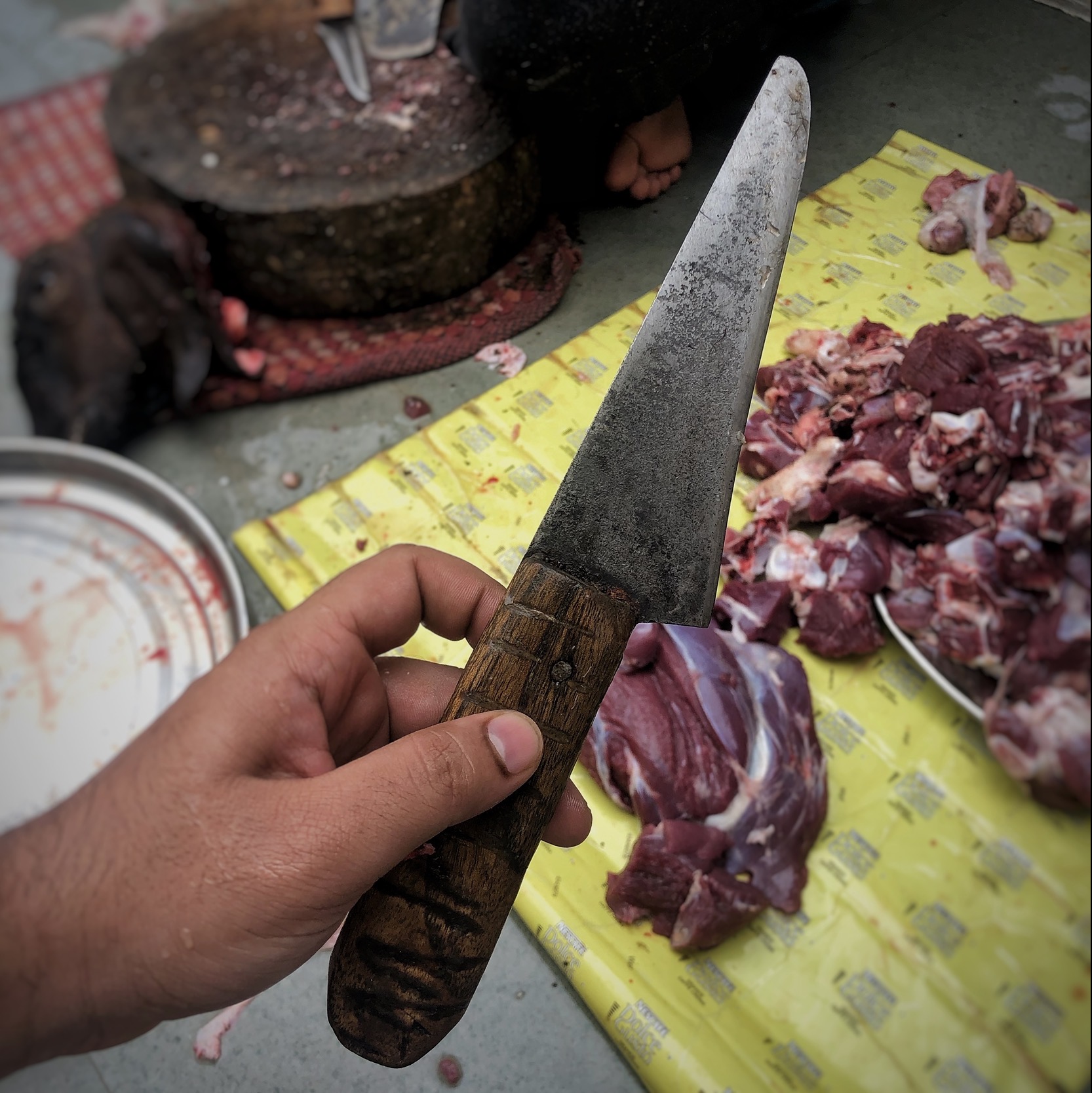
At my house this happens after the Eid khutbah. Our butcher, Tabrez, comes to our place first, on priority.
For someone detached from slaughter, it can be a visually overwhelming experience.
There is the metallic smell of fresh blood leaving the severed jugular, mixing with the sweet smell of green leaves the animal had been chewing that morning. When the carcass is hung and opened, another smell appears entirely.
It is the smell of death.
Fresh death.
Unless you have grown accustomed to it, witnessing the process can be difficult.
Within two hours the animal has been completely butchered and the meat and offal separated. The lungs, liver and kidneys are cooked first and served with naan.
The people who spent the morning helping with the butchery now sit around the dastarkhan and eat the freshest possible offal as payment, nourishment and breakfast.
Then it is back to work.
The large pots come out of storage and mutton curry is made en masse. There may be twenty-five people in the house and still more food must be cooked to send to relatives and neighbours.
More family begins arriving from their respective cities.
Meanwhile, I retire to my room to shower, change my blood-stained kurta and wash the lingering smell of goat from my hair.
There is something about the mutton curry made on Eid.
Everyone says it tastes better than it does at any other time of the year.
Of course it does.
The goat was slaughtered that morning. Much of the meat being cooked has barely had time to enter rigor mortis. The sheer quantity being cooked changes things too. Protein-rich juices and gelatin from bones slowly work their way into the curry.
It becomes rich and slick, coating the palate.
Refrigerated overnight, it can set almost like a container of good veal stock.
Then everyone sits together.
There is an extremely efficient system of passing plates around the table, with the hosts strategically positioned between guests so they can continuously ladle out more curry and force another naan or spoonful of rice onto anyone foolish enough to suggest they might be full.
Eventually lunch ends and everyone falls into a starch-induced slumber.
There are qualities that define us as human beings no matter how distant or culturally different we imagine ourselves to be.
Sometimes they are expressed through something as simple as a smile, something understood across continents without translation.
Sometimes they appear through something much more complicated, like communal butchery.
Food becomes political particularly quickly when death is involved.
But it has become easier for many of us to make pronouncements about slaughter because modern abundance has allowed us to become almost completely detached from where food comes from.
For most of human history, slaughtering an animal was not an abstract industrial process happening somewhere beyond sight.
It was an occasion.
A sudden abundance of food.
A gathering.
A celebration of life that necessarily involved death.
Watching families in Louisiana and families here in India, I kept noticing the same things.
People gathered.
They talked.
Close family, distant cousins and friends came together around an animal that had, almost accidentally, provided the reason for everyone to be in the same place.
People spoke about the year that had passed.
They celebrated what had gone well.
They spoke about their sorrows.
And they remembered the people who had sat among them the previous year but were no longer there.
The animal becomes a kind of centrepiece to all of this. For that day, and for several days afterwards, there is abundance. There is meat in the house. There is food to share. Nobody around the table has to wonder where the next meal is coming from.
Then dawn eventually comes again.
People begin preparing to return home, carrying portions of the animal with them.
The goodbyes begin.
Inshallah, we will meet again next year.
And perhaps we will.
Or perhaps, by then, one of us will be among those being remembered.
This piece is dedicated to my grandfather, the late Haji Jahursa Diwan, who was one of the first people to tell me that I might someday become a journalist.