
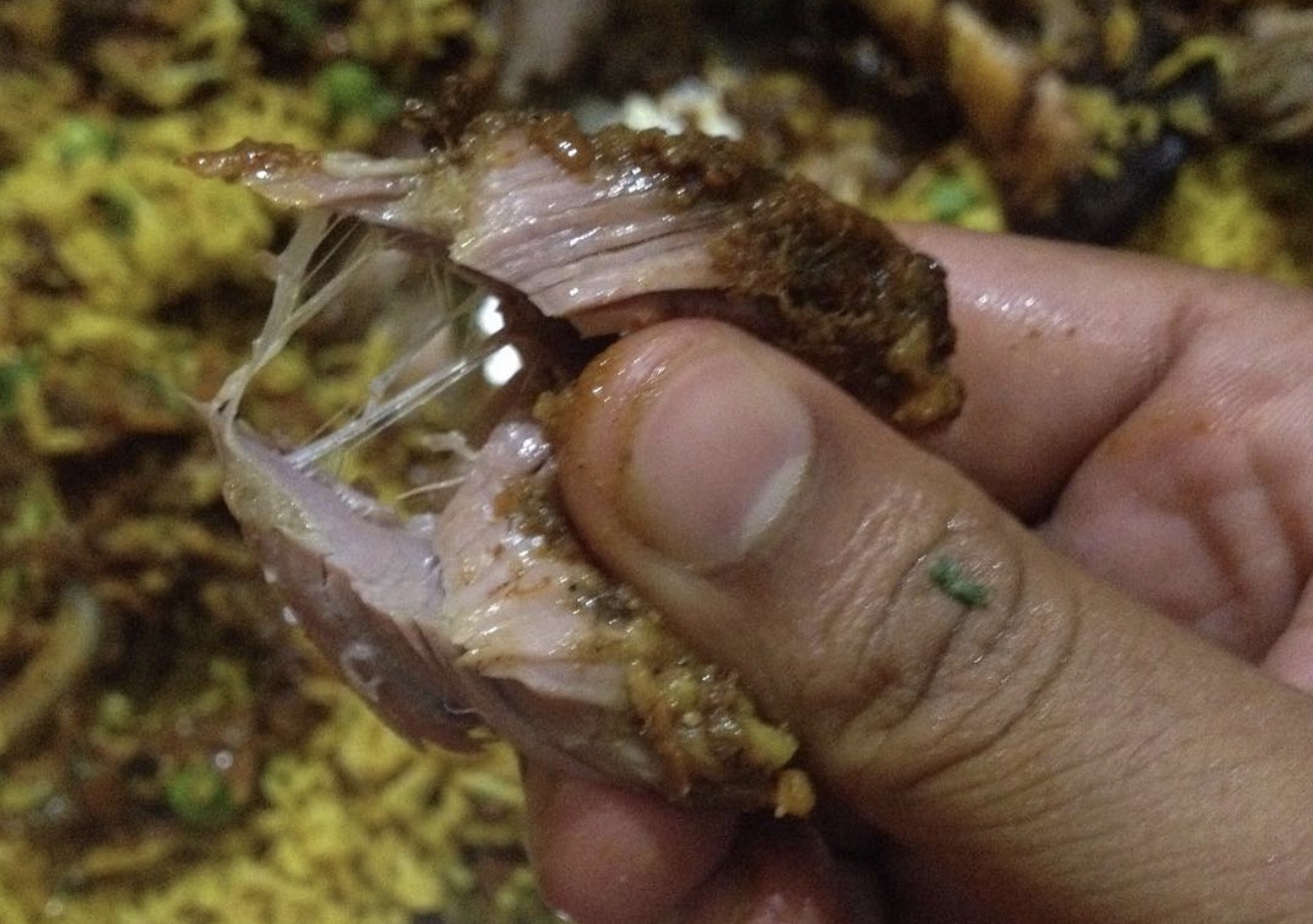
There is always a good piece, and nobody at the table has to identify it. Sometimes it is the chicken leg, browned more deeply than the rest and carrying enough skin and fat to make it unmistakably better. Sometimes it is the middle piece of fish with fewer bones, the section of meat in a biryani that has somehow remained whole through cooking, the crisp corner of something fried, the larger half of a samosa that split unevenly, or one of the two broad cheeks sliced cleanly from a ripe mango. Whatever it is, everyone knows what it is worth.
Children know especially well. A child may understand almost nothing about the household they live in. They do not know how much the electricity bill costs, who borrowed money from whom, why their father has been unusually quiet after work, why their mother has started buying one brand of rice instead of another, or why meat has appeared fewer times this month. But give one sibling the chicken leg and another sibling a smaller piece and suddenly both children possess a sophisticated and highly adversarial theory of justice. They remember who received the larger piece yesterday, who was allowed seconds last time, and whether a previous injustice has now established precedent.
When I was young, I thought meals simply arrived divided. Someone got the drumstick, someone got the wing, someone received the softer piece, someone was given more gravy, someone was served first, and someone else looked into the serving bowl, saw what remained, and announced that they were not very hungry. None of it appeared particularly meaningful because children tend to experience meals as finished objects. The decisions that created those portions happened before the plate reached them, and so the food seemed to have arranged itself.
It had not. Someone had decided who should receive which piece, whether consciously or by instinct, and once you begin paying attention to those decisions, a family dinner starts looking less like a collection of individual appetites and more like a small social system.
The child may get the tender meat. The grandfather gets the softer piece because his teeth are failing. The father may be served first because he is considered the head of the household, because he leaves early for physical work, or because those two explanations have become so intertwined over time that nobody remembers which one came first. A guest receives the largest serving. The person who cooked may eat last. The youngest may be indulged, the eldest may be honoured, and the sick person may temporarily outrank everybody.
Somewhere inside all of this, someone also says, “I like this piece,” while taking the one nobody else particularly wanted. As children, we tend to believe those explanations. If your mother says she likes the chicken neck, then she likes the chicken neck. If she says the wing has more flavour, perhaps adults simply possess some advanced appreciation for joints.
If she cuts a mango, gives you one broad cheek, gives the other to someone else, and keeps the seed for herself, scraping at the fibres with her teeth until there is almost nothing left on it, you do not necessarily understand that a decision has been made. You simply learn that this is how mangoes are divided.
It can take an embarrassingly long time to notice that there are three people eating and somehow the same person is always holding the seed. The easy interpretation is sacrifice, but family life is rarely clean enough to offer such simple conclusions. Perhaps she really does like the seed. Perhaps after twenty or thirty years of taking the wing, the neck, the end piece and the portion with more bone, those things have genuinely become her preference. Taste changes through repetition, and what begins as accommodation can eventually become familiarity, and familiarity can become comfort.
That possibility is more interesting than the sentimental version because it raises a harder question. How many preferences begin as choices, and how many begin as adjustments made around other people? If a person spends enough years taking the chicken neck so someone else can have the leg, there may eventually come a day when the neck really is the piece she reaches for first. At that point the family can no longer tell where generosity ended and preference began.
Sometimes a family does not know what its mother likes because it has spent decades learning what she is willing to give away.
The mother, though, is only one part of the system, because the good piece does not always move toward the person with the least power. Sometimes it moves toward the person with the most. A father may be served first. An elder may receive the first roti. The head of the household may choose before anyone else does. The person who pays for the food may assume a larger claim over it, whether that claim is ever stated openly or not.
Families usually have explanations for these arrangements. He works harder. He needs more. He earns. He is older. He should be respected. Sometimes these things are completely true. A person doing exhausting physical labour may genuinely need more food than someone whose work is sedentary. A growing teenager may require more than a grandparent. Someone recovering from illness may need the most nutritious portion at the table. Unequal portions are not automatically unjust.
The more revealing question is who gets to decide what makes the inequality fair. That decision tells you something about the values of the household, because one of the first political systems a child encounters may be the dinner table. Resources are finite, authority distributes them, and everybody has a different status within the system. Favouritism is alleged, previous allocations are remembered, grievances are carried forward, and children discover early that adults do not define fairness the same way they do.
Children usually begin with mathematics. One for me, one for you. The same number, roughly the same size. Adults operate with a much messier accounting system in which need, affection, age, labour, gender, money, health, seniority, respect, hospitality and power are all allowed to alter the calculation.
You learn a great deal about a household from what it does with the thing it cannot divide equally.
Scarcity makes this easiest to see. If there are eight drumsticks and four people, nobody has had to reveal very much about themselves. If there are four pieces of chicken for six people, the situation becomes more interesting. Two mango cheeks and three children require a decision. One egg divided between siblings requires a decision. A family that can afford meat only occasionally must decide not merely how to cook it, but how to distribute it.
In abundance, generosity can be almost costless. Scarcity forces generosity to have a price because somebody has to take less for somebody else to receive more.
A parent who grew up hungry may automatically give the larger portion to a child because the entire meaning of having escaped scarcity is contained in watching that child eat without calculation. A father may receive more because his body is expected to carry the hardest labour. A grandmother may get the softest piece because age has changed what she can chew. A daughter may receive less because everybody assumes she requires less, while a son gets an extra egg because someone believes boys need greater strength.
A nutritional explanation can hide a social one remarkably well. Families distribute food according to hunger, certainly, but they also distribute it according to what they believe each person contributes, what each person represents, how much authority they hold, how vulnerable they are, and what the household believes it owes them. Food becomes a way of turning abstract values into physical portions.
Gender becomes impossible to ignore once you look at who is actually doing the serving. Who cooked the meal, who remembers which person likes less chilli, who knows there is only enough dal for one more serving, who notices someone needs more rice, who gets up halfway through eating, and who remains standing while everybody else begins?
The person with the greatest authority over food can simultaneously have the least freedom at the table.
That contradiction is part of what makes domestic food labour difficult to understand. The person holding the serving spoon may know everybody's preferences, decide who receives what, and control the movement of food through the household, yet still be socially expected to eat later, take what remains, or treat their own appetite as the most flexible one. Domestic authority and domestic servitude can live inside the same body without cancelling each other out.
Cooking itself is only one part of this work. Feeding requires a different kind of attention. It means knowing who has eaten and who has not, who wants more and who is pretending not to want more, which child is likely to complain, which elder can no longer chew a certain thing, what remains in the pot, and who still has to be served. When this labour is done well, it almost disappears. Everybody eats and the meal looks effortless.
Then a guest enters the house and the entire hierarchy can rearrange itself. Suddenly the better fruit appears, the portions of meat grow larger, the sweets that household members had apparently been forbidden from touching become available immediately, and the good crockery emerges from whatever archaeological chamber of the kitchen cupboard it occupies between visits.
The guest often receives the good piece before the family does, and describing this only as generosity misses part of what is happening. Hospitality can contain affection, religion, pride, reputation, class aspiration and anxiety all at once. A family that carefully controls its spending on ordinary days may become extravagant for an evening because allowing a guest to leave believing there was not enough food can feel like a moral failure.
The guest therefore occupies a peculiar place in the hierarchy of the meal. They are temporarily outside the family and yet may outrank the people who live inside the house. The largest serving moves toward them because the household's honour has, for the duration of the meal, become tied to their experience of it. There is something extraordinary about the fact that people may economize on themselves without shame but feel embarrassed to economize on a guest. The best meat goes outward, the best fruit goes outward, and the household measures itself partly by what it is willing to surrender.
Class complicates the question further because there is no universal agreement about what the good piece actually is. One household prizes the fish head while another discards it. One person reaches for boneless meat while another considers meat without bones bland. Someone wants marrow; someone else finds the idea revolting. The piece associated with poverty in one generation can reappear as luxury in another, photographed beautifully and described with enough language to justify a significantly higher price.
Class does not simply determine what people can afford to eat. It also teaches them what they are supposed to desire and what they are supposed to feel embarrassed by. A parent who grew up eating bones and offcuts may dream of feeding their children boneless meat because bonelessness represents abundance. The child, having never experienced the scarcity that made bones unavoidable, may later spend a surprising amount of money ordering roasted bone marrow in a fashionable restaurant.
Upward mobility therefore changes not only what is available, but what counts as desirable. Sometimes people gain the ability to buy foods their parents could not afford. Sometimes they gain the ability to reject the foods their parents depended on. Sometimes, one generation later, those same foods return as heritage, nostalgia or refinement. Taste may feel intimate and individual, but it is also shaped by class, memory and aspiration.
Migration adds another layer because families can leave the conditions that created certain habits without leaving the habits themselves. A family moves, income improves, meat becomes easier to buy, fruit appears throughout the year, and supermarkets offer trays of portions trimmed until one piece looks almost identical to another. There are finally enough good pieces for everybody.
Still, someone gives theirs away. Someone insists they are full. Someone saves the better portion for a child who is no longer a child. A mother who spent twenty years ensuring everybody else ate first does not necessarily stop because the refrigerator is suddenly fuller. A father who grew up in a house where wasting food bordered on sin may continue scraping the plate clean long after food security has stopped being a concern.
I remember one of my grandmother’s brothers pouring water onto his plate and scraping up whatever remained before drinking the water, because it was nutrition he did not want to see wasted. Even though he was a government engineer, he did this because of habit and the place he came from.
Scarcity can disappear long before the habits created by scarcity do.
A migrant family can carry an old economy inside a new refrigerator, and the choreography of the old table can survive after the material conditions that created it have changed completely.
Working in professional kitchens made this contrast especially obvious to me because restaurants spend enormous effort trying to eliminate precisely this kind of inequality.
Portions are weighed, steaks are cut to specification, fish is divided carefully, and every plate is expected to leave the pass with the same number of scallops, the same amount of sauce and roughly the same experience attached to the same price. Professional kitchens treat consistency almost as a moral virtue because two guests paying for the same dish should receive the same dish.
Then the plates reach the table and people immediately begin redistributing them. Someone pushes the larger piece toward another person. Someone insists their companion try half. Someone offers the last bite and is refused. Someone says they are full when they plainly are not.
The kitchen standardizes the portion, but the table reintroduces relationship.
That difference matters because equality is only one of the things people want from food. They also use it to care for one another, to honour someone, reward them, indulge them, protect them, impress them, establish rank, express gratitude or make them feel chosen.
Someone saves you the crisp corner because they know you like it. Someone removes the bones from your fish without asking. Someone sets aside a sweet before everyone else finishes it because they know you are coming home late.
These gestures are small enough to pass unnoticed, which is precisely why they matter. Grand declarations of love do not happen every day. Dinner does. Much of what families feel for one another is therefore expressed through repetition rather than spectacle, and a considerable amount of love may arrive disguised as allocation.
There comes a point, though, when the direction of that allocation begins to change. One day there is a drumstick in the serving dish and instead of waiting for it to arrive on your plate, you put it on your mother's.
She refuses it. You tell her to eat it. She puts it back. You return it. She refuses again, and then a third time, because decades of instinct do not disappear simply because the child at the table has finally begun noticing what has been happening.
The two of you may laugh because the argument is objectively ridiculous. It is only a piece of chicken, and neither of you is starving. You say you do not want it, she says she does not want it either, and somewhere during the exchange it becomes obvious that neither of you is really discussing appetite anymore.
You want her to eat that drumstick because you have finally understood that the better pieces you received as a child did not simply belong to you. Someone had decided that you should have them.
You want, impossibly, to reverse all those earlier decisions through one small act, to push the good piece back across the table as though it could carry with it every larger portion, every mango cheek, every fresh roti and every piece of meat with fewer bones.
Perhaps somewhere inside her, beneath decades of saying she prefers the wing, the neck or the piece with more bone, there is also simply a woman who would like the drumstick. Perhaps there is not. The uncertainty matters because love and hierarchy often occupy the same table, and the two are not always easy to separate.
A mother can genuinely enjoy feeding her family while living inside a culture that expects her to feed herself last. A father can receive the best portion because his family loves him and because the household has learned that his appetite should carry greater weight. A guest can be honoured out of sincere generosity while also becoming a measure of the family's reputation. A child can be given more because they are loved and because the parents' memory of scarcity makes the child's hunger difficult to tolerate.
The mistake would be to force these arrangements into neat categories. Family life is rarely kind enough to make love innocent of power or power completely absent from love. Food reveals this because it turns abstract relationships into visible decisions. Someone serves. Someone waits. Someone chooses. Someone receives.
As you get older, you begin watching your parents' plates in a way you never did when you were young. You notice whether they have taken enough before serving yourself. You ask why your mother's portion is smaller. You choose the softer piece for your father.
You peel fruit for them, remove bones, push the better portion across the table, and discover that the people who spent decades feeding you are often extraordinarily difficult people to feed.
Perhaps this is one of the quieter ways childhood ends. For years, somebody watched your plate while you had the luxury of watching only your own. Then one day you begin paying attention to theirs.
There is something painful in realizing that none of this can become a proper accounting exercise. You cannot repay every chicken leg. You cannot reconstruct every mango and put the cheeks back onto your mother's plate. You cannot reopen every childhood dinner and ask everyone what they actually wanted before habit, hierarchy or affection answered on their behalf.
You can only begin noticing now.
At some future meal, there will be another good piece. Your mother may be there, or your father, your partner, your child, an elder, a guest, or someone whose hunger you have only recently learned to notice. The piece will sit in the serving dish for a moment before someone reaches for it, and nothing about that moment will appear important from the outside.
But the question underneath it will be the same one families have been answering quietly for generations. Food is never distributed according to hunger alone. It is distributed according to what we believe people are worth, what we owe them, what they need, what status they occupy, what we remember about them, and what we are willing to surrender for them.
Where the good piece goes tells you something about the entire table.